 Add to Chrome
 Add to Firefox
 Add to Edge
BlazeEdit: Generalist Image Editing on Mobile Devices with Image-to-Image Diffusion Models
May 27, 2026
The remarkable generation quality of modern diffusion models often comes at the cost of massive parameter counts, which necessitate server-side inference with significant computational costs and potential privacy risks. Consequently, there is growing momentum toward developing efficient on-device alternatives. While recent efforts have optimized text-to-image models for mobile hardware, they remain relatively bulky, typically ranging from 0.5B to 1B parameters. We present BlazeEdit, a highly efficient, generalist image-to-image diffusion model tailored for on-device deployment. By identifying that many practical image editing tasks do not require text-based guidance, we eliminate the text-conditioning components and develop a multi-task architecture that consolidates object removal, outpainting, tone correction, relighting, and sticker generation into a single, compact model of only 195M parameters. BlazeEdit achieves a substantial reduction in download size and memory overhead while maintaining competitive generation quality. It completes a full inference pass in just 290ms on a Pixel 10, delivering a seamless, privacy-preserving, and lightning-fast experience for generalist image editing on the edge.

Inference-Time Scaling for Diffusion Models beyond Scaling Denoising Steps
Jan 16, 2025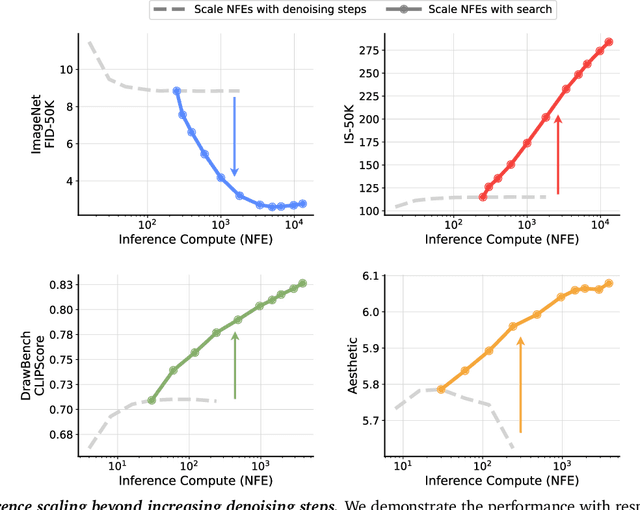
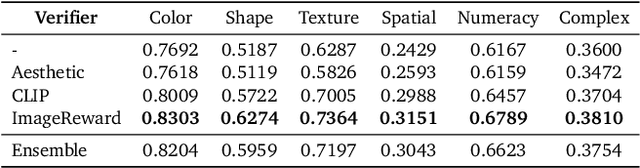
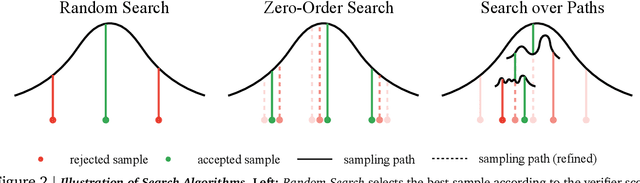
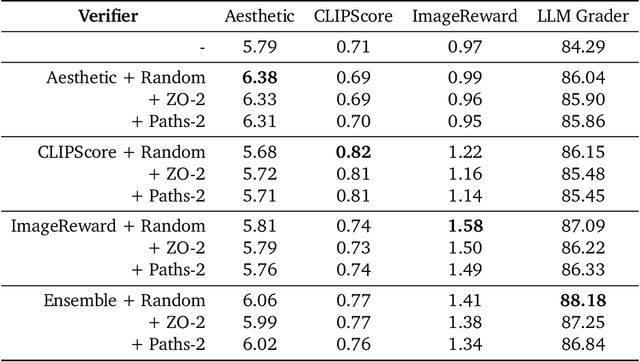
Generative models have made significant impacts across various domains, largely due to their ability to scale during training by increasing data, computational resources, and model size, a phenomenon characterized by the scaling laws. Recent research has begun to explore inference-time scaling behavior in Large Language Models (LLMs), revealing how performance can further improve with additional computation during inference. Unlike LLMs, diffusion models inherently possess the flexibility to adjust inference-time computation via the number of denoising steps, although the performance gains typically flatten after a few dozen. In this work, we explore the inference-time scaling behavior of diffusion models beyond increasing denoising steps and investigate how the generation performance can further improve with increased computation. Specifically, we consider a search problem aimed at identifying better noises for the diffusion sampling process. We structure the design space along two axes: the verifiers used to provide feedback, and the algorithms used to find better noise candidates. Through extensive experiments on class-conditioned and text-conditioned image generation benchmarks, our findings reveal that increasing inference-time compute leads to substantial improvements in the quality of samples generated by diffusion models, and with the complicated nature of images, combinations of the components in the framework can be specifically chosen to conform with different application scenario.